Intel & Insights
How to read the Paid search tab
What a competitor buys on Google Ads, the copy they run — and an alert when they start bidding on your brand.
Every competitor has a Paid search tab: the Google Ads keywords they’re bidding on and the ad copy they’re running on them. It’s the one angle that shows what a rival is willing to pay to reach your buyers, rather than what they earned.
Paid search isn’t ranked. More ad spend isn’t a stronger position, so Outmano doesn’t score it — see Understanding the angles.
When they’re not running ads
Most competitors aren’t, and the tab says so plainly rather than showing an empty table:
- Not running Google Ads — Outmano checked and found no paid search activity for them in the US market.
- Checking for ads… — they’re queued for the next weekly sweep.
If they stop, the tab says roughly when they stopped rather than reverting to a blank state, so a campaign ending is itself readable as a change.
Bidding on your brand
If any of their paid keywords contains your brand name, a banner appears at the top of the tab: Bidding on your brand, with the count and up to five of the offending keywords alongside the ad copy they’re running on them.
This means they’re paying to appear when someone searches for you by name — usually the most urgent thing on the page, and it ships as a critical change, so it reaches your Slack alerts and the weekly digest too.
Matching is deliberately conservative. Outmano derives your brand terms from your own product’s name and domain, matches them only as whole words — so “outmano alternatives” counts and “discount mano” doesn’t — and ignores terms shorter than four characters, because a false alarm here is worse than a missed one. Brand terms come from your own product, so this section needs your own product tracked, and it never appears on your own product’s tab.
What changed since last time
When a fetch turns up movement, the tab summarizes it before the detail:
- Started bidding — keywords they’ve newly bought
- Stopped bidding — keywords they’ve dropped
- Rewrote ad copy — same keyword, new message
Copy rewrites are often the most telling of the three: a rival changing the promise on a keyword they already own usually means something moved in their positioning.
Paid keywords and ad messaging
Paid keywords lists the terms they’re buying. The “As of” date is when the underlying search-results data was captured, which refreshes roughly monthly — so it can be older than the date Outmano last checked.
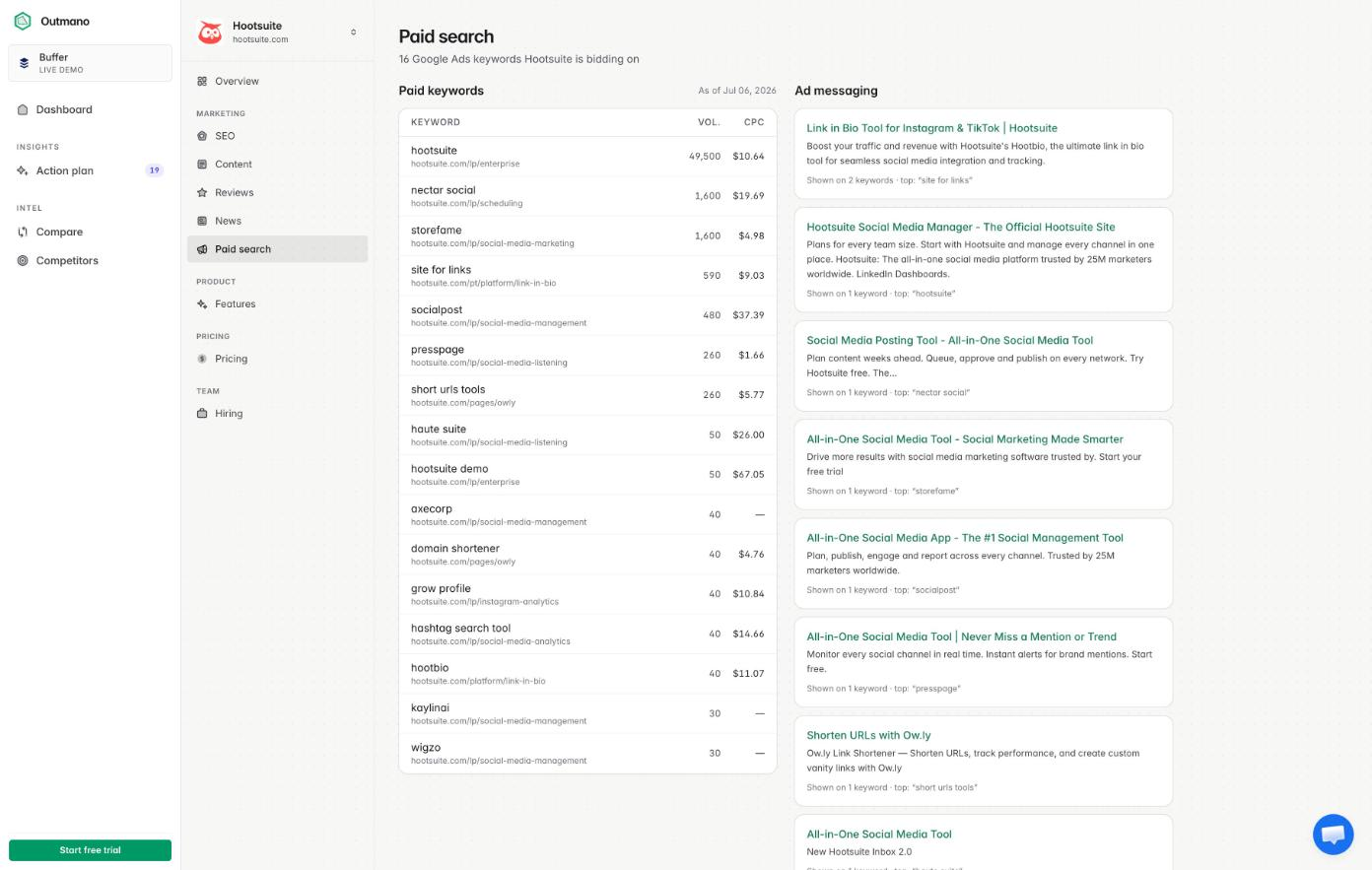
Ad messaging groups the actual ad titles and descriptions they run, showing how many keywords each is used on and the top keyword for each. Read this side for their pitch: the headline they’ve decided is worth money is usually a cleaner statement of their positioning than anything on their homepage.
How often it refreshes
Paid keywords are re-fetched weekly, in the small hours of Monday UTC, after the SEO readings that tell Outmano whether the domain is running ads at all.